Sukun is the Content Communications Manager at ClickLearn, focused on user training and documentation best practices.
Key Takeaways
Poor documentation significantly hinders team efficiency, increases errors, and prolongs onboarding, costing organizations valuable time and resources. According to McKinsey & Company, employees waste nearly 1.8 hours daily searching for information, which translates to about 20% of the workweek lost. This issue is exacerbated by outdated guides, scattered information, and reliance on a few subject matter experts, leading to confusion, repeated mistakes, and delayed onboarding. The implications are profound, as poor documentation can stifle business growth, impede training, and result in increased operational risks. Over time, these challenges compound, negatively affecting productivity, compliance, and overall business performance.
Action Items
- Standardize documentation processes to ensure consistency and clarity.
- Centralize knowledge in a single, accessible source to reduce search time.
- Regularly update documentation to reflect current processes and systems.
- Provide role-based access to ensure relevant information is available when needed.
- Implement automated documentation systems to capture processes in real time.
Read more
Poor documentation slows teams, increases errors, and delays onboarding. Discover the hidden cost of poor documentation and how it impacts business performance, efficiency, and growth.
Employees spend nearly 1.8 hours every day just searching for information, according to a report by McKinsey & Company. That is almost 20 percent of the workweek lost to something that should be simple: finding the right answer at the right time.
Now layer this with outdated guides, scattered SOPs, and processes that live in people’s heads instead of systems. What looks like a small documentation gap quietly turns into delayed onboarding, repeated mistakes, rising support tickets, and frustrated teams.
This is the hidden cost of poor documentation, and most organizations underestimate how quickly it compounds.
Poor documentation is not just an operational issue. It directly impacts how fast your teams learn, how consistently they execute, and how confidently your business scales. The longer it stays unaddressed, the more it drains productivity, increases risk, and slows down every transformation initiative you invest in.
What Does Poor Documentation Actually Look Like in an Enterprise?
Poor documentation is not always obvious. It does not show up as a single failure. It shows up in small, daily inefficiencies that teams start accepting as normal.
In most enterprises, it looks like this:
Outdated and unreliable content Processes change, but documents do not. Teams follow steps that no longer match the system, leading to confusion, errors, and rework.
Knowledge is scattered across multiple tools Some information lives in PDFs, some in emails, some in shared drives, and some in people’s heads. There is no single source of truth, so employees spend more time searching than doing.
Heavy dependency on SMEs When documentation is incomplete, employees rely on experienced team members for answers. This creates bottlenecks and pulls SMEs away from high-value work.
Lack of standardized processes Different teams follow different versions of the same process. This leads to inconsistent outcomes, especially in large or distributed teams.
No support at the moment of need Even when documentation exists, it is often not accessible when users actually need it, inside the application or workflow.
These are the most common documentation challenges in enterprise environments, and they often go unnoticed because teams build workarounds. Over time, these workarounds become the real problem, slowing down operations, increasing risk, and making it harder to scale.
Why Documentation Is Important for Business Growth and Stability
Before we talk about the cost of getting documentation wrong, it is important to understand what strong documentation actually does for a business.
At its core, documentation is what turns individual knowledge into an organizational asset. It ensures that work does not depend on memory, availability, or guesswork.
Here is why documentation is important for business growth:
It enables scale without chaos As teams grow, processes need to be repeatable. Good documentation makes it possible to onboard new employees faster and maintain the same quality of work across locations and teams.
It reduces dependency on individuals When knowledge sits with a few people, progress slows down. Documentation removes this dependency by making information accessible to everyone who needs it.
It improves consistency and accuracy Clear, step-by-step documentation ensures that tasks are done the same way every time. This reduces errors, avoids rework, and improves overall process reliability
It supports compliance and audit readiness In regulated environments, documentation is not optional. It provides proof of processes, controls, and decisions, which is critical for audits and compliance requirements.
Strong documentation builds a foundation for efficiency, control, and growth. Without it, even the best systems and tools fail to deliver their full value.
The Hidden Cost of Poor Documentation in Organizations
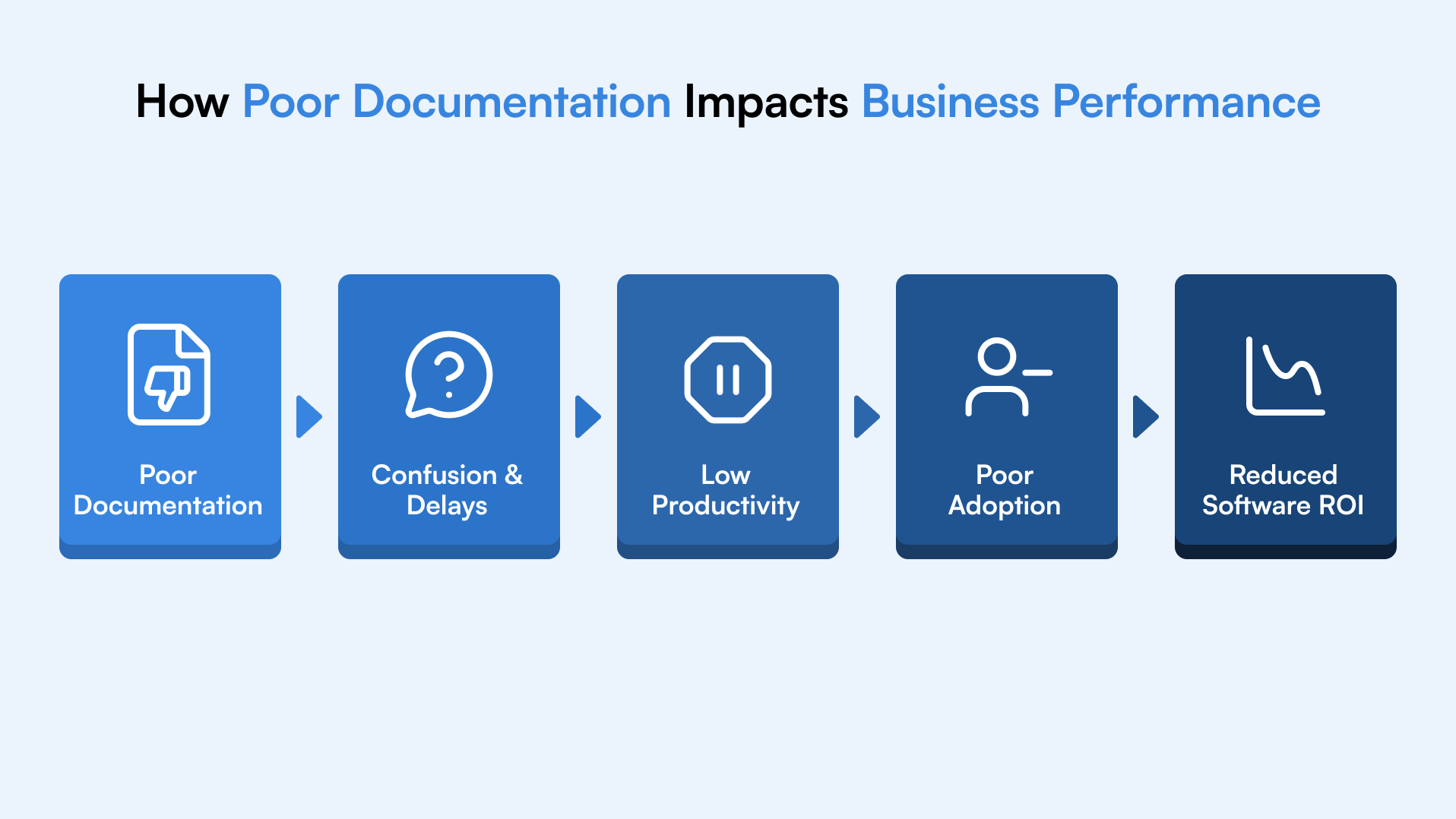
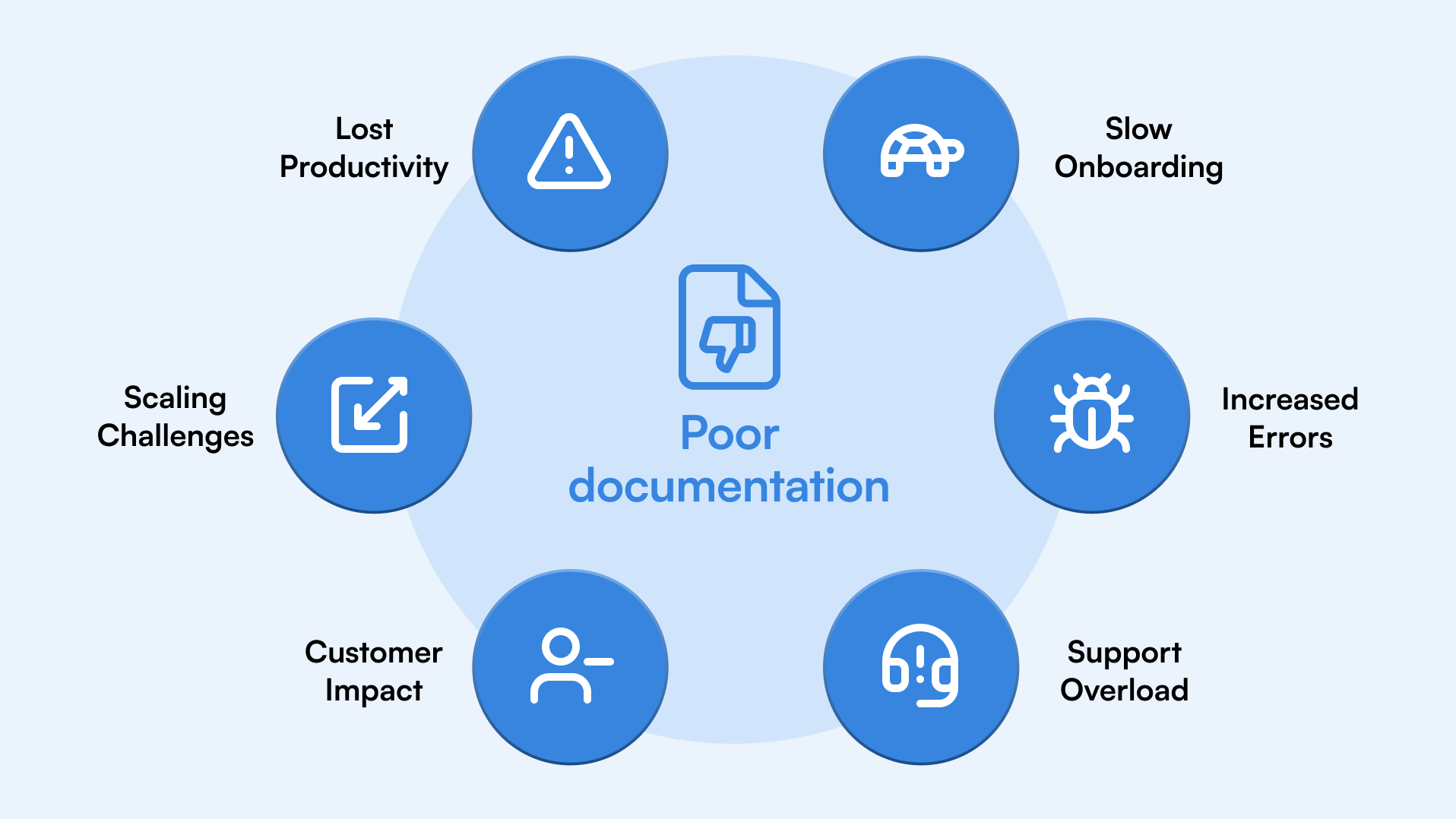
The hidden cost of poor documentation includes lost productivity, slower onboarding, repeated errors, rising support load, and inconsistent customer experiences. Over time, these issues do not stay isolated; they compound and start impacting business performance, team efficiency, and growth.
What makes this worse is that these costs are rarely tracked directly. They show up as delays, confusion, and missed targets, making them easy to ignore but expensive to sustain.
Let’s break down where the real impact shows up.
Lost Productivity and Time Waste One of the most immediate effects of poor documentation is time loss. Employees spend a significant part of their day searching for information, validating steps, or asking colleagues for help. Every interruption breaks focus and adds context-switching overhead.
This is where the poor documentation’s impact on business becomes visible. Work slows down, simple tasks take longer, and overall productivity drops without anyone realizing the root cause.
Slower Onboarding and Training Delays When documentation is incomplete or outdated, onboarding becomes inconsistent and slow. New hires depend heavily on trainers or team members to understand processes. This increases ramp-up time and delays their ability to contribute effectively.
The effects of poor process documentation are clear here: training becomes reactive instead of structured, and learning depends more on people than on systems.
Increased Errors, Rework, and Compliance Risks Without clear and updated documentation, employees rely on assumptions. This leads to process deviations, incorrect execution, and frequent rework. In regulated industries, this can also result in compliance gaps and audit issues.
The effects of poor process documentation extend beyond mistakes; they introduce risk into everyday operations.
Overloaded Support Teams and SME Dependency Poor documentation creates a constant flow of repeated questions. Employees reach out to support teams or subject matter experts for basic queries that should have been documented. This increases the workload on experienced team members and slows down decision-making.
These are common documentation challenges in enterprise environments, where knowledge is not distributed effectively, and teams become dependent on a few individuals.
Poor Customer Experience and Service Delays Internal confusion often reflects externally. When teams do not have clear guidance, responses become inconsistent. Resolution times increase, and customers experience delays or incorrect information.
This is another critical poor documentation impact on business, where internal inefficiencies directly affect customer satisfaction and brand trust.
Scaling Becomes Difficult and Expensive As organizations grow, undocumented or poorly documented processes become a major barrier. It becomes difficult to replicate workflows, train new teams, or maintain consistency across locations. The cost of training increases, and performance varies across teams.
This is where the cost of bad documentation in organizations becomes most visible. Growth slows down, and scaling requires more effort than it should.
The Long-Term Business Impact of Poor Documentation
The real problem with poor documentation is not just daily inefficiencies; it is the long-term impact on business performance.
Over time, small gaps in documentation start affecting strategic outcomes. What begins as delays and confusion turns into missed ROI, low adoption, and talent challenges.
Here is how the poor documentation impacts business plays out at a deeper level:
Reduced ROI on software and process investments Organizations invest heavily in ERP, CRM, and other enterprise systems. But without proper documentation, users struggle to adopt these systems effectively. Features remain underused, processes are bypassed, and the expected return on investment is never fully realized. This is a direct cost of bad documentation in organizations that often goes unnoticed.
Employee frustration and higher attrition When employees constantly struggle to find answers or rely on others to complete tasks, frustration builds. Over time, this affects engagement, confidence, and job satisfaction. High-performing employees expect clarity and efficiency, not guesswork.
Slower digital adoption and transformation Digital initiatives depend on how well users adapt to new systems and processes. Poor documentation slows this down. Teams take longer to learn, adoption remains inconsistent, and transformation efforts lose momentum.
How to Fix Poor Documentation Without Slowing Down Your Teams
Most teams know their documentation is not working. The real challenge is fixing it without adding more work or slowing down operations.
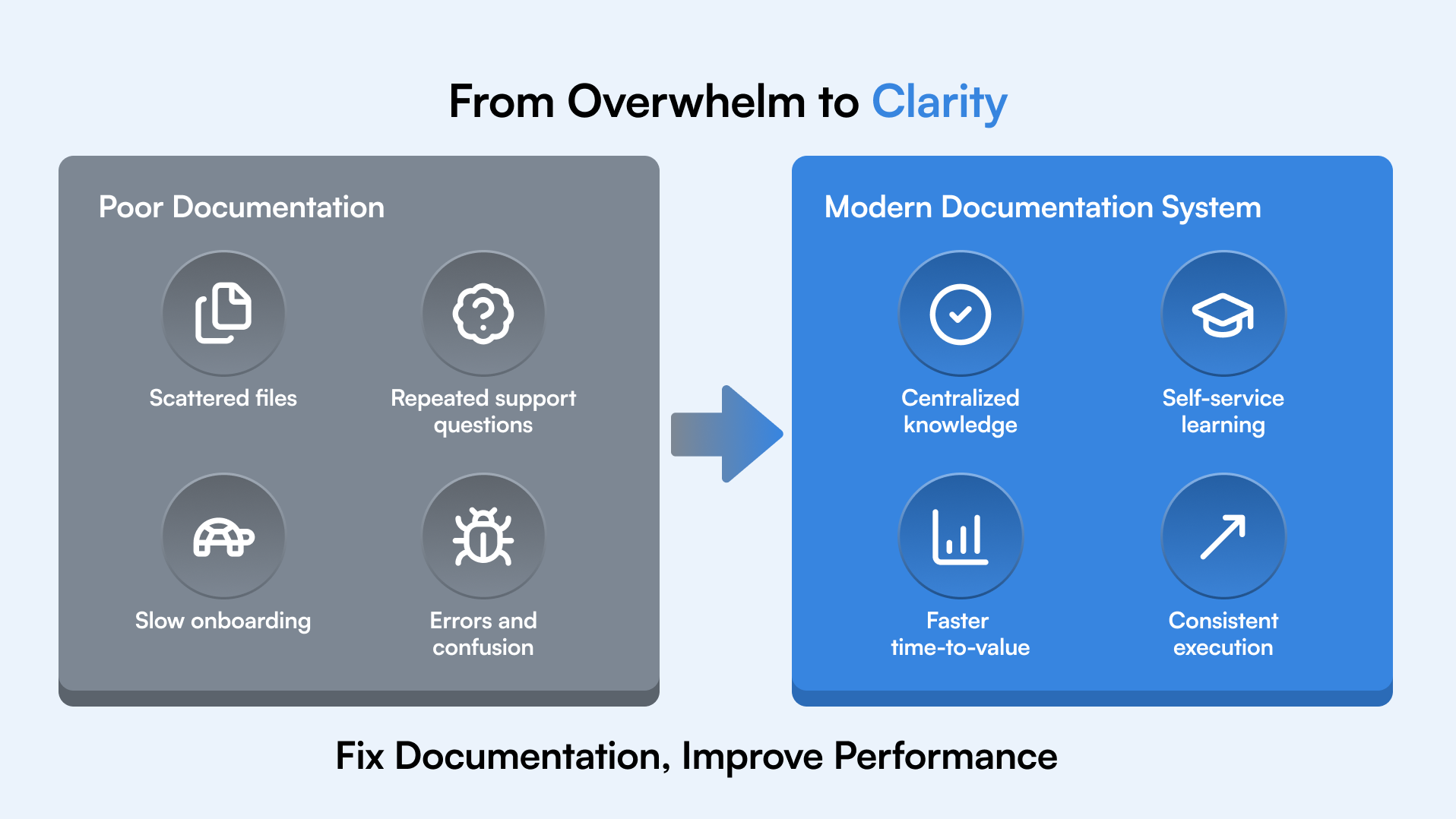
The goal is not to create more documents. It is to build a system where documentation stays accurate, accessible, and easy to maintain as processes evolve.
Here is how leading teams solve common documentation challenges in enterprise environments:
Standardize how processes are documented Start by defining a clear structure for all documentation. Every process should follow the same format, steps, and level of detail.This removes ambiguity and makes it easier for employees to follow instructions without second-guessing. It also ensures consistency across teams and departments.
Centralize knowledge in one accessible system Documentation should not be spread across tools, folders, and emails. Create a single source of truth where employees can quickly find the latest and most accurate information. This reduces search time and avoids confusion caused by multiple versions of the same process.
Keep documentation updated as systems change Outdated documentation is as risky as no documentation. Build a process where documentation is updated alongside system or process changes. This ensures that what employees see always reflects current workflows.
Provide role-based and contextual access Not everyone needs the same level of information. Make documentation relevant to the user’s role and task. Deliver guidance where work happens, inside the application or workflow, so employees do not have to leave their task to search for help.
What Modern Documentation Systems Should Look Like
Most organizations already know why documentation is important for business. The real shift now is moving from static documents to systems that actually support how work happens today. Modern documentation is not created once and stored. It is continuously generated, updated, and delivered at the right moment of need.
Here is what that looks like in practice:
Automated documentation capture Instead of manually creating guides, modern systems capture processes as users perform them. This removes the time and effort spent on writing step-by-step documentation and ensures accuracy from the start.
Multi-format outputs for different learning needs Not every user learns the same way. The same process should be available as written guides, videos, and interactive walkthroughs. This makes training more effective and reduces dependency on trainers or support teams.
In-app guidance where work happens Documentation should not live in separate folders or tools. Users need guidance inside the application, exactly when they are performing a task. This reduces errors, speeds up execution, and improves confidence.
Easy updates as systems evolve Enterprise systems change frequently. Modern documentation systems ensure that updates are reflected automatically, so teams are never working with outdated information.
This is where platforms like ClickLearn come in. ClickLearn helps organizations move from manual, outdated documentation to automated, always up-to-date process guidance. It captures user actions in real time and converts them into multiple formats, from step-by-step guides to videos and in-app support. The result is simple: teams spend less time creating and maintaining documentation and more time using it to work faster, reduce errors, and adopt systems with confidence.
Bringing It All Together
The hidden cost of poor documentation is not just about inefficiency; it is about lost potential. When documentation is fragmented, outdated, or hard to access, it slows down every part of the business, from onboarding and operations to customer experience and growth.
But when documentation becomes automated, accessible, and aligned with how people actually work, it turns into a business advantage. That is the shift modern organizations are making. And that is what drives real adoption, consistency, and long-term scalability.
Resources
New webinars, events and blogposts
Webinar
Join our Fireside Chat and learn how to transform your Dynamics CRM training with insights from Texas Disposal.