

Key Takeaways
The rise of Digital Adoption Platforms (DAPs) reflects a critical need for organizations as they navigate complex software systems. With the DAP market projected to grow from USD 702 million in 2023 to USD 3.6 billion by 2032, it’s clear that while companies invest heavily in software like ERP, CRM, and HR systems, users often struggle to adapt. A DAP provides in-app guidance that helps users complete tasks efficiently right when they need it, minimizing confusion and errors. This tool not only enhances user confidence but also streamlines onboarding, reduces support costs, and improves data quality by ensuring proper usage of software features.
Action Items
- Evaluate your organization's software complexity and user challenges to determine DAP necessity.
- Consider implementing a DAP to improve user onboarding and reduce reliance on IT support.
- Monitor user engagement and feedback to measure the effectiveness of the DAP.
- Regularly update DAP content to reflect system changes and ensure relevance.
- Train teams on how to utilize the DAP effectively for better adoption and productivity.
What Is a Digital Adoption Platform? The Digital Adoption Platform market reached USD 702 million in 2023 and is projected to reach USD 3.6 billion by 2032, according to Fortune Business Insights and our Digital Adoption Platform Market Insights 2025.
This rise tells you something important. Companies invest in new software every year, but users continue to struggle to keep up.
Imagine this: a new CRM layout goes live on Monday morning. Within minutes, teams start asking:
Where did the workflow move?
Why does the screen look different?
How to complete a task they handled last week?
And… IT gets pulled in.
Training teams rush to update slides. Managers deal with missed steps and slow execution. Nothing is wrong with the software. The real issue is that people do not know what to do at the exact moment they need help.
This is where a digital adoption platform, or DAP, steps in. A DAP sits on top of your business apps and gives users clear, in-app guidance. Walkthroughs, prompts, and simple step instructions appear right on the screen, so people learn while doing instead of switching between manuals, tabs, or sessions.
The friction a DAP removes is the one you never plan for. The hesitation during a new rollout. The confusion after a small UI change. The errors that break data. The repetitive questions that drain IT and training teams. This is why organizations want to know what a digital adoption platform is, why you need a digital adoption platform, and when it becomes essential for ERP, CRM, and HR systems.
This guide answers all three questions in a simple, practical way so you can decide whether a DAP is the right move for your company.
What Is a Digital Adoption Platform?
A digital adoption platform is a guidance layer that sits on top of your existing software and helps users complete tasks correctly. If you are looking for a simple digital adoption platform, think of it as on-screen assistance that appears at the exact moment someone needs help.
- simple step-by-step walkthroughs
- prompts that explain what to do next
- field highlights that show where to click
- tips that reduce mistakes during tasks
- SAP or Oracle Cloud
- Salesforce or Dynamics 365
- Workday or other HR platforms
Why Do Companies Need a Digital Adoption Platform?
Most companies invest heavily in ERP, CRM, and HR systems, yet users still struggle with everyday tasks. The problem is not the software. It is the effort it takes for people to learn, remember, and repeat the right steps without help. This is why you need a digital adoption platform. It closes the gap between how the system is designed and how people actually use it.
Low adoption of ERP and CRM tools
Many users avoid complex workflows or create shortcuts that break consistency. A DAP helps by guiding them through the correct steps on the screen.
Inefficiency during onboarding
New hires spend too much time figuring out basic tasks. With in-app guidance, they can learn while doing, which shortens their ramp-up time.
High training and support load
IT and training teams often repeat the same answers. A DAP reduces this load through:
- real-time prompts
- self-help tooltips
- guided instructions
Poor data quality due to workflow mistakes
Incorrect entries, skipped fields, and incomplete steps affect reporting, forecasting, and compliance. A DAP improves data accuracy by highlighting required fields and explaining what each step needs.
Slow adoption of new features
Teams hesitate when updates change screens or workflows. A DAP helps users adopt new features faster by showing them what has changed and how to use it.
The hidden cost of not using a DAP
Without in-app guidance, teams rely on:
- Tribal knowledge
- Outdated documents
- Repeated manual support
This leads to delays, inconsistent execution, and higher training costs.
A digital adoption platform removes these everyday friction points and helps users work with confidence inside the tools they rely on.
When Do You Actually Need a DAP?
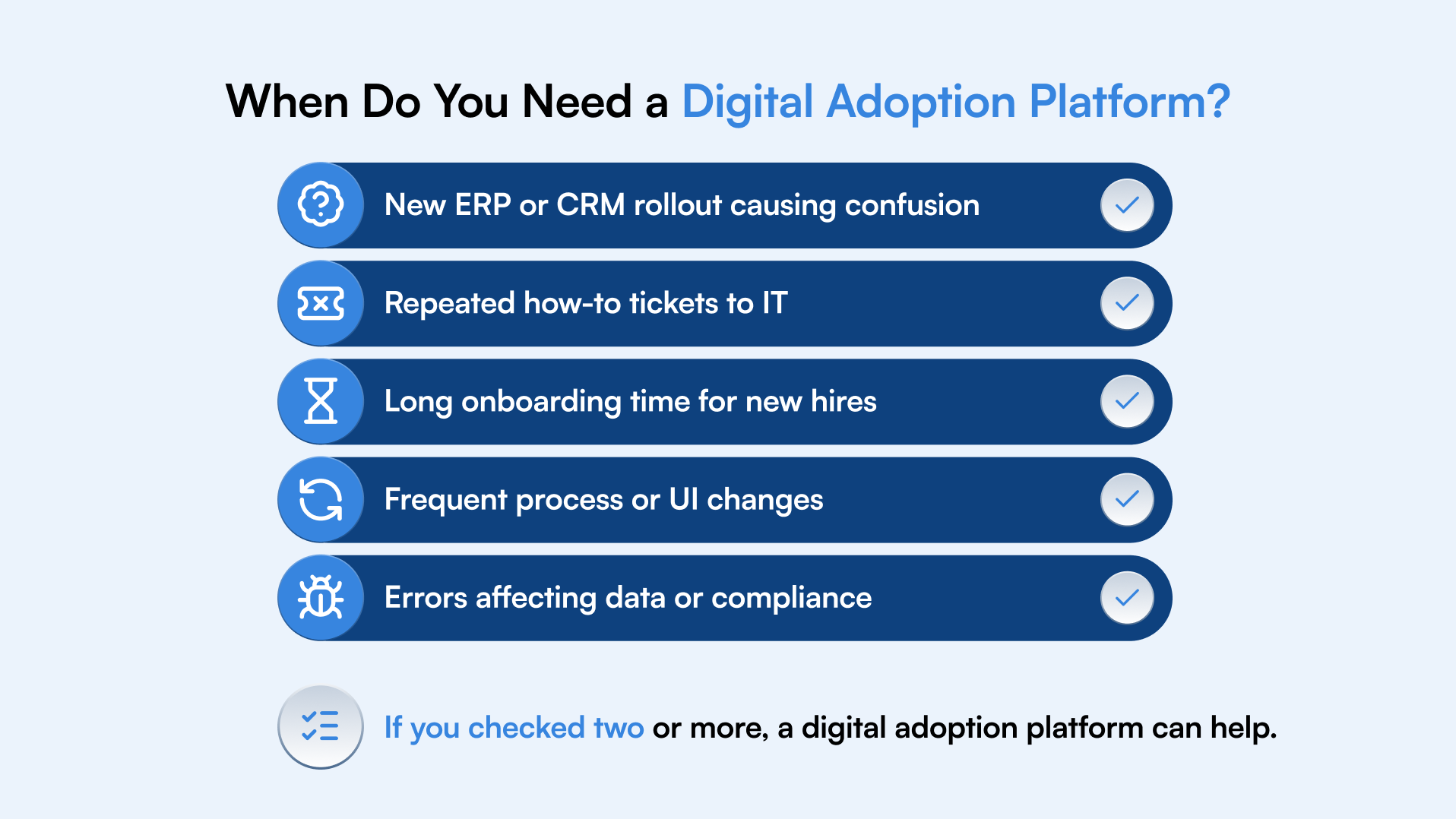
Most companies hit a point where training alone stops working. Slides explain the process once, but real problems show up later, during daily work. If you are asking when you need a digital adoption platform, the answer usually shows up through clear signals inside your teams.
After a major ERP or CRM rollout
New modules, UI changes, or workflow updates often slow teams down. Users forget steps, skip fields, or avoid new processes altogether. When adoption drops right after a rollout, it is a sign that users need guidance inside the system, not another training session.
When processes change frequently
Policies, approvals, and system rules do not stay static. If your teams keep asking what changed or how to follow the new steps, a digital adoption platform helps by delivering updated guidance directly in the workflow.
When support tickets repeat the same questions
If your helpdesk keeps answering the same questions, users are not learning in the flow of work. A DAP reduces this pattern by showing instructions at the moment of confusion, before a ticket is raised.
When onboarding takes too long
New hires often spend weeks figuring out internal systems. If ramp-up time keeps increasing, a digital adoption platform shortens the learning curve by guiding users through real tasks as they work.
When errors affect data and compliance
Missed fields, incorrect entries, and incomplete steps lead to poor data and compliance risk. When mistakes start impacting reports or audits, in-app guidance becomes essential.
When multiple tools are part of one workflow
Many tasks span multiple systems, including ERP, CRM, HR, and approval systems. Switching between tools increases confusion and delays. A digital adoption platform connects these steps and helps users move across systems without getting stuck.
When You Do NOT Need a DAP
A digital adoption platform delivers strong value in complex environments, but it is not a requirement for every organization. In some cases, adding a DAP too early creates more overhead than benefit. Knowing when you do not need a digital adoption platform helps set the right expectations.
Your team is small and easy to support
When teams are small, questions are resolved quickly through direct conversations. If users can get instant help from a colleague or manager, in-app guidance may not add much value yet.
Your software is simple to use
Some tools have short forms, clear navigation, and limited steps. If users can complete tasks without confusion, a digital adoption platform may be unnecessary.
Your processes have low complexity
If workflows do not involve multiple approvals, strict data rules, or sensitive steps, users usually do fine with basic training and documentation.
Your systems rarely change
When screens, fields, and rules stay the same for long periods, existing training material remains relevant. A DAP becomes more useful when frequent changes make content outdated fast.
You have limited compliance or audit requirements
If your business does not depend on controlled processes, accurate audit trails, or consistent data entry, the need for in-app guidance is lower.
A digital adoption platform creates the most impact when workflows are long, systems change often, and mistakes are costly. If your environment is still simple and stable, it makes sense to wait and revisit the decision as your systems and teams grow.
What Are the Benefits of a Digital Adoption Platform?
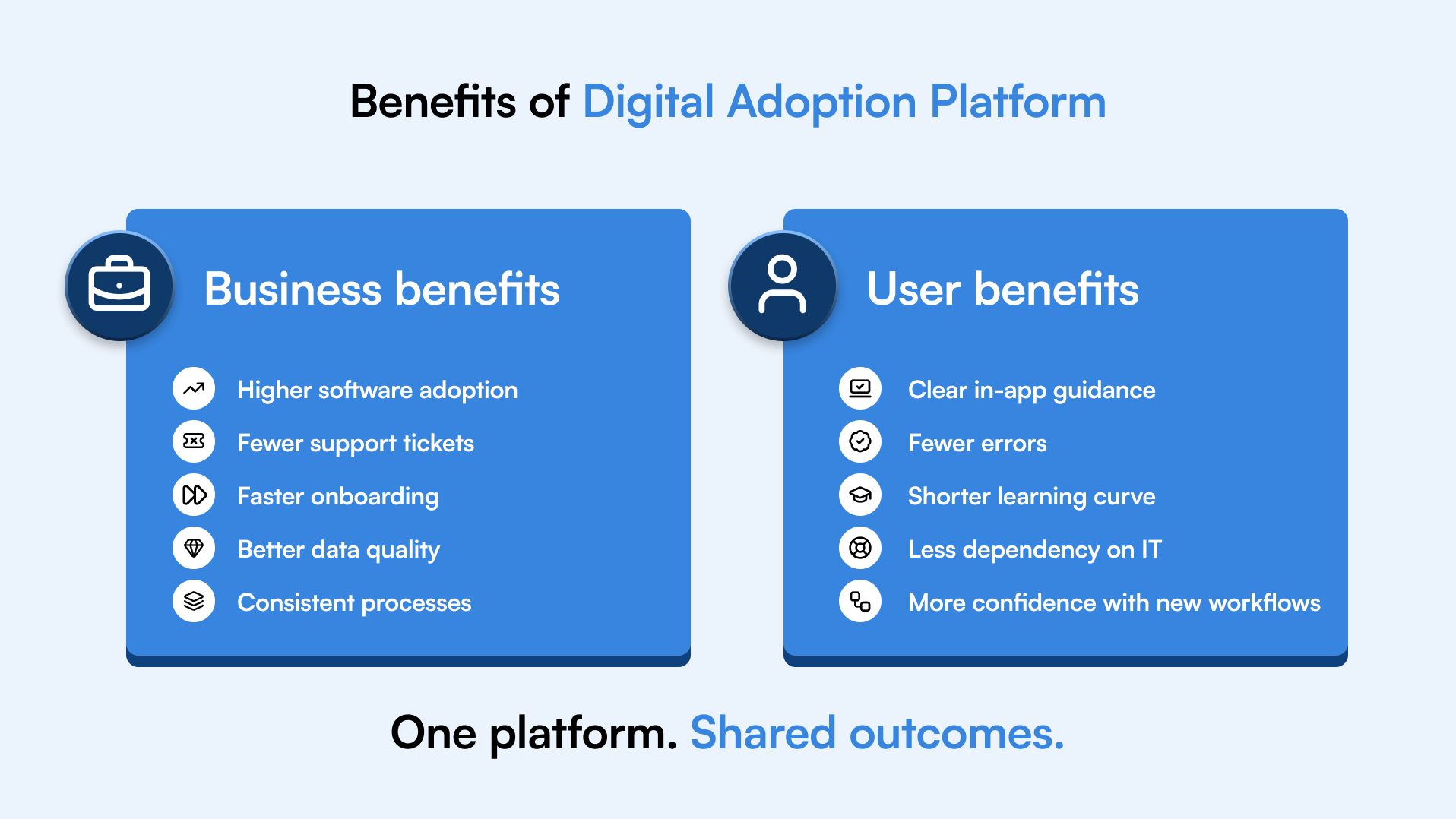
The benefits of a digital adoption platform show up quickly when guidance moves from documents into daily work. Instead of relying on memory or training sessions, users get help at the exact moment they need it. This creates value for both the business and the people using the system.
DAP Benefits for the Company
Higher adoption across critical systems
ERP, CRM, and HR tools deliver value only when people use them correctly. A digital adoption platform increases adoption by guiding users through the right steps inside the application.
Lower training and support costs
Repeated questions drain IT and training teams. With in app guidance, users solve problems on their own, which reduces:
- support tickets
- repeated training sessions
- dependency on SMEs
More consistent process execution
When everyone follows the same guided steps, processes become predictable. This reduces skipped actions, missed approvals, and workflow variations that slow operations.
Better data quality
Clear field level guidance reduces incorrect entries and incomplete records. Cleaner data improves reporting, forecasting, and compliance across the organization.
Faster onboarding and smoother rollouts
New hires learn by doing. System updates roll out with less resistance. A digital adoption platform shortens ramp up time and helps teams adapt faster to change.
DAP Benefits for End-Users
Clear guidance during real work
Users do not have to guess or search for instructions. The guidance appears inside the screen they are working on.
Fewer mistakes and less rework
Step-by-step instructions reduce errors and save time spent fixing issues later.
A shorter learning curve
Users build confidence while completing real tasks, not by memorizing steps during training.
Less dependency on others
Answers are available in the system, so users do not need to interrupt teammates or IT for help.
More confidence with new workflows
When changes roll out, users feel comfortable trying new features because guidance is already in place.
Together, these benefits make a digital adoption platform a practical investment for organizations that want better execution, cleaner data, and stronger adoption across their business applications.
How Does a DAP Support ERP and CRM Systems?
ERP and CRM platforms carry the most important workflows in any organization. They are also the systems where users make the most mistakes because the steps are long, detailed, and change often. A digital adoption platform helps by guiding users through these tasks directly inside the application.
Support for process-heavy ERP systems
Tools like SAP and Oracle Cloud involve complex steps for finance, supply chain, procurement, and approvals. A DAP breaks these workflows into simple, guided actions.
It helps users:
- understand what each field or screen requires
- avoid missed steps during month-end or project tasks
- complete long forms without confusion
Better adoption of CRM tools
CRM platforms like Salesforce and Dynamics 365 get frequent updates and new features. Sales teams and service reps may skip or misunderstand new workflows. A DAP helps by
- guiding reps through new screens
- showing how to log activities correctly
- reducing delays in pipeline updates and customer tasks
Help for HCM and HR workflows
Onboarding, offboarding, and payroll tasks in HCM systems often involve multiple screens and rules. A DAP gives users clear directions during each step.
Teams benefit when they can
- complete HR tasks without searching for help
- avoid errors in sensitive employee data
- follow the right process during policy changes
Consistent experience across multiple apps
Most workflows span multiple systems, such as CRM to ERP or HR to finance tools. A DAP guides users through these cross-app workflows so they do not get stuck switching between screens.
A DAP adds stability across ERP, CRM, and HCM systems by giving people the help they need in the exact moment they need it. This reduces confusion, speeds up execution, and improves overall adoption.

How Do You Choose the Right Digital Adoption Platform?
Choosing the right DAP tool is not about ticking feature boxes. It is about finding software that fits your systems, your teams, and the way work actually gets done. A digital adoption platform should reduce effort, not add another layer of complexity.
Start with application compatibility
The first check is simple. The DAP tool must work reliably with the systems you already use. This usually includes:
- ERP platforms like SAP or Oracle Cloud
- CRM tools like Salesforce or Dynamics 365
- HR systems such as Workday
If a DAP struggles with your core applications, adoption will suffer.
Evaluate the quality of in-app guidance
Look closely at how guidance is delivered. The tool should support:
- step-by-step walkthroughs
- field-level highlights
- role-based instructions
The guidance should feel natural inside the workflow, not disruptive.
Check analytics and visibility
A good DAP tool shows where users struggle and where adoption drops. Useful insights include:
- task completion rates
- drop off points
- time spent per step
These metrics help teams improve processes and training decisions.
Review how easy it is to update content
Systems change often. Your DAP software should let teams update guidance quickly without heavy technical effort. Easy editing and fast updates matter more than complex controls.
Look for support across regions and roles
If your teams operate globally, the tool should support multiple languages and role-specific guidance. This keeps instructions relevant for different users.
Assess implementation effort and long-term value
A DAP tool should be quick to roll out and easy to scale. Focus on setup time, onboarding support, and the ability to grow with new modules and teams.
The right digital adoption platform fits into your environment quietly, supports users during real work, and continues to deliver value as your systems evolve.
“The software is awesome and we would be lost without it. It has paid for itself 10 times over. The service we receive from the people in your organisation is equally awesome. Keep up the great work”
“I think this software application is the best on the market in terms of keystroke capturing. There is a high-level of customization and it provides a lot of options in terms of publishing material (both from a template and platform perspective)."
“Hands down, ClickLearn is the most efficient solution on the market for creating and updating user instructions both written and interactive.”
Common Challenges With DAP Adoption and How to Fix Them
Introducing a digital adoption platform brings clear value, but teams may still face challenges during rollout. Most of these issues come from unclear processes, outdated content, or limited user awareness. The good news is that each challenge has a simple, practical fix.
Users feel overwhelmed by too much guidance
If the DAP shows prompts on every screen, users may ignore them. This usually happens when teams try to guide every single action instead of focusing on high-impact steps. The fix is to keep guidance short, relevant, and limited to the parts of the workflow where people actually struggle.
Guidance does not match the latest system changes
When ERP or CRM updates go live, existing instructions may not match the new screens. This leads to confusion and reduces trust in the DAP. The solution is to review guidance after every release and update it as part of your change management routine.
Content does not reflect real workflow variations
Some workflows differ by region, role, or business unit. If everyone sees the same instructions, users may follow the wrong steps. A better approach is to create targeted versions of the guidance and show each user the instructions that fit their role or location.
Teams rely on the DAP but forget the bigger process
If guidance becomes a crutch, users may not learn the reasoning behind a task. The fix is to combine DAP guidance with training or short refreshers that explain the purpose of the process, not just the steps.
Adoption is slow because users are not aware of the DAP
Some teams do not notice the new guidance or do not understand why it is there. A simple onboarding plan, short announcement, or quick demo helps users understand the value and encourages them to rely on the DAP during real tasks.
How to Measure Digital Adoption Success?
Once a digital adoption platform goes live, the next step is to measure whether it is improving the way users work – see webinar here. A DAP provides clear analytics that show where users struggle, how often they rely on guidance, and how much faster they complete tasks. These insights help teams track real progress and refine the guidance over time.
Time to proficiency
This measures how quickly new hires or existing users become comfortable with key workflows. If the time to proficiency drops after adding a DAP, it is a strong sign that in-app guidance is helping users learn faster.
Feature and workflow adoption
Some features in ERP or CRM systems remain unused simply because users do not know how to access them. A DAP helps highlight these steps. Higher usage rates and fewer skipped tasks show that users are following the right paths.
Error reduction
Fewer mistakes in forms, approvals, or data entry mean the guidance is working. This has a direct impact on reporting accuracy, billing cycle, and operational efficiency.
Drop in support tickets
If the same how-to questions start to disappear from your support queue, your DAP is reducing dependency on IT and trainers. This is one of the clearest indicators of value.
Faster workflow completion
Users finish tasks faster when they have on-screen guidance. A shorter time per workflow means improved confidence and fewer interruptions.
User feedback
Analytics are important, but user feedback adds context. When employees say that the guidance helps them complete tasks without stress or confusion, it confirms that the DAP is improving the overall experience.
Conclusion
A digital adoption platform gives your teams the support they need inside the systems they use every day. It removes the friction that slows down ERP, CRM, and HR workflows and helps users complete tasks with confidence. When guidance appears in the right moment, training becomes easier, support tickets drop, and users adapt faster to new processes or updates.
A DAP is not just a help tool. It is a way to protect your software investment by making sure people actually use the features you pay for. It improves productivity, supports change management, and reduces the time spent coaching users through the same steps again and again.
As your systems grow more complex and your teams rely on more digital workflows, a DAP becomes a practical way to keep everyone aligned. It helps your organization deliver consistent processes, maintain data accuracy, and bring new users up to speed without slowing down operations.
If your goal is to drive better adoption and improve daily execution across your business apps, a digital adoption platform is one of the simplest ways to get there.