DAP Market Insights 2025: Statistics Powering Better Enterprise Software Adoption

These DAP Market Insights clarify the current state of digital adoption and provide actionable benchmarks for enterprise technology leaders. By leveraging these DAP Market Insights, your organization can better understand where investment and training have the largest impact.
Picture of Puja More
Puja More
Writer at ClickLearn, focusing on user adoption and process documentation software.
Key Icon

Key Takeaways

The blog post emphasizes that the success of digital adoption hinges on user engagement rather than the quality of software itself. As enterprises transition to prioritizing user adoption strategically, the Digital Adoption Platform (DAP) market is projected to grow significantly, from USD 702 million in 2023 to USD 3.6 billion by 2032. Key statistics reveal that 70% of large enterprises will adopt DAPs by 2025, and structured adoption practices yield an 85% ROI, compared to just 22% for those without. Furthermore, DAP tools can reduce training time by up to 40%, enhancing productivity and lowering training costs. The insights underscore the importance of addressing user adoption as a critical element in maximizing the return on digital investments.

Action Items
- Integrate DAP readiness into your transformation roadmap.
- Benchmark your adoption maturity against industry standards.
- Identify high-friction systems for immediate DAP implementation.
- Replace traditional training methods with guided in-app training.
- Establish a structured onboarding plan utilizing DAP content.
- Conduct a 30-day adoption improvement sprint to track progress and user satisfaction.

Read more

DAP market insights show that technology investments don’t fail because the software is weak; they fail because people don’t adopt it. The 2025 digital adoption landscape highlights a clear shift: many enterprises are now treating user adoption as a strategic priority rather than an afterthought.

DAP market insight statistics for 2025 reveal where the market is heading and outline actionable steps organizations can take today to improve adoption, reduce training time, and maximize ROI.

DAP Market Insights: The Global Market Is Accelerating - Here’s What It Means for You

Digital adoption has become a billion-dollar category, touching every major digital transformation program.

What the data says

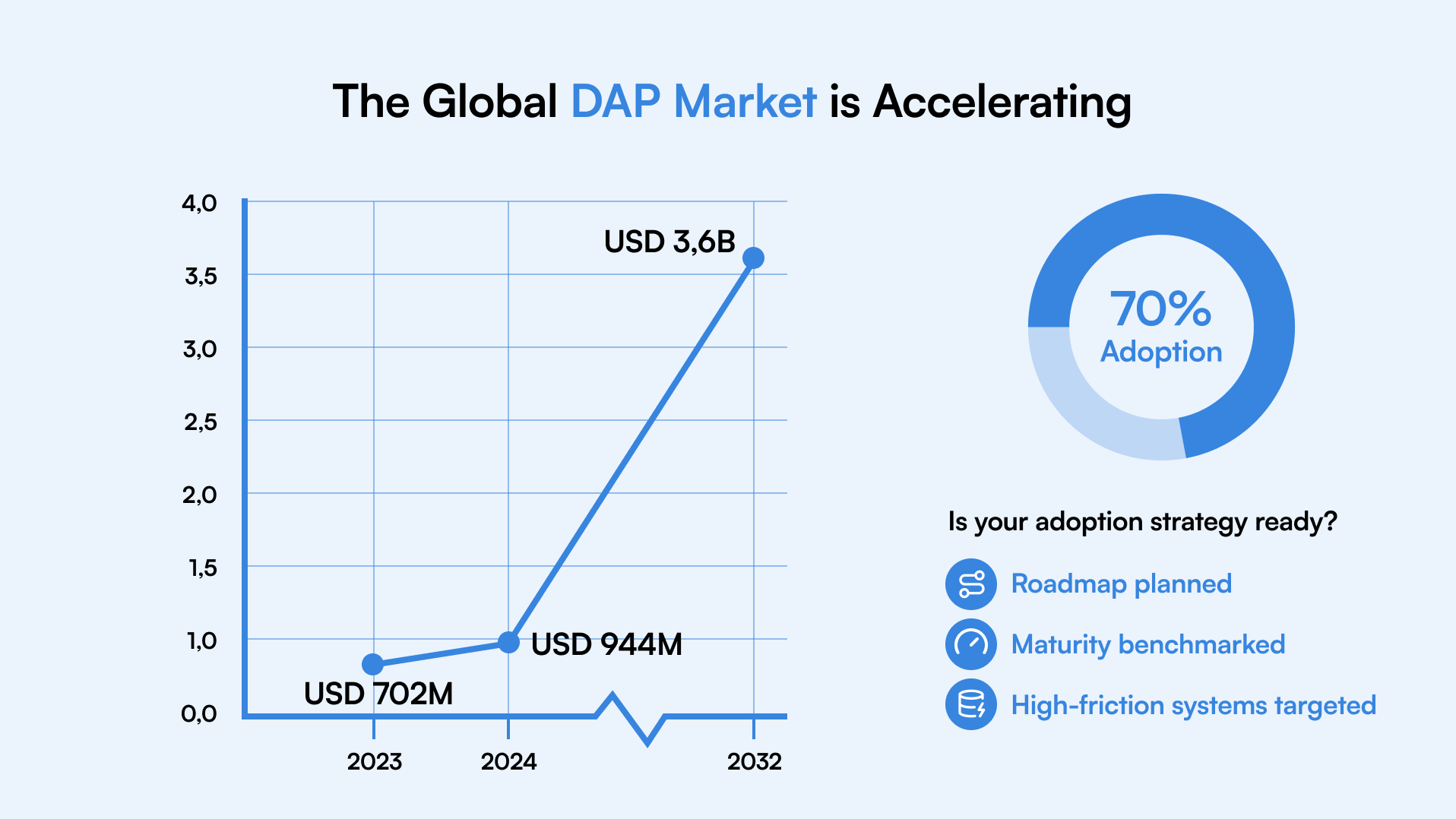
  • The global DAP market was USD 702M in 2023, growing to USD 943.6M in 2024, and projected to reach USD 3.6B by 2032. (1)
  • According to Gartner, 70% of large enterprises are set to adopt a DAP by the end of 2025. (2)

What you should do

  • Make DAP readiness part of your transformation roadmap.
    If your organization is upgrading ERP, CRM, HR, or supply chain systems, adoption planning must sit at the center of the project.
  • Benchmark your adoption maturity.
    Compare your current training, documentation, and user support against the 70% moving toward structured adoption.
  • Identify systems where friction is highest.
    These are your top candidates for DAP deployment.
Dap Market Insights -Global Dap Market Is Accelerating

DAP ROI Statistics Show Why it Can’t Be Reactive Anymore

A DAP isn’t just a training tool; it delivers measurable financial impact.

What the data says

The following DAP Market Insights for 2025 are drawn from industry forecasts and adoption benchmarks that signal strong investment and adoption trends.

  • Structured adoption practices drive 85% ROI, while organizations without them see just 22% ROI. (3)

What you should do

  • Use ROI data to prioritize which apps need DAP support first.
    ERP, CRM, and financial systems typically show the fastest return.
  • Build structured adoption workflows.
    Replacing scattered training with user guidance, auto-updated documentation, and in-app help boosts ROI by 4x.
  • Track adoption metrics, not just system usage.
    Focus on completion rates, time-to-proficiency, and process accuracy.
Dap Roi Statistics

Training Time and Cost Are Falling — If Digital Adoption Is Done Right

Training is one of the highest hidden costs in software rollouts. Companies can reduce training time with DAP.

What the data says

  • Training time decreases by 40% with digital adoption tools. (4)
  • Organizations report a 30–40% improvement in training efficiency and a 25% rise in employee productivity. (5)
  • Annual training cost per learner dropped from USD 1,207 to USD 954 as digital training matured. (6)

What you should do

  • Replace heavy classroom sessions with guided, in-app training.
    Users learn faster when the system teaches them how to work.
 
  • Use DAP analytics to optimize your onboarding path.
    Identify where users get stuck and redesign workflows around those friction points.
 
  • Build a 4-week onboarding plan powered by DAP content.
    This becomes the blueprint for consistent, repeatable, trackable training.
Training Time And Costs Decrease With Digital Adoption Done Right

Turn User Adoption Gaps Into Quick Wins

Most organizations know adoption is a problem, but don’t know where to start fixing it. These actions help you identify immediate opportunities.

Start with a simple diagnostic

  • Where do users spend the most time learning?
  • Which features have low usage?
  • Which processes cause support tickets?
  • Where do users abandon workflows?
 

What you should do

  • Pick 1–2 processes with the highest friction.
    Apply DAP guidance there first for immediate gains.
 
  • Run a 30-day adoption improvement sprint.
    Track process accuracy, completion rates, and user satisfaction.
 
  • Establish weekly adoption KPIs.
    Time-to-complete, number of errors, guided steps used, and support ticket reduction.
User Adoption Kpis

A Practical Framework to Start Your Digital Adoption Journey in 2026

Turn the statistics into a repeatable roadmap your teams can use.

5-step framework to Start Your DAP Journey

  • Step 1: Identify systems with the highest training cost
  • Step 2: Select workflows that have the biggest user friction
  • Step 3: Deploy guided steps, interactive help, and auto-updated documentation
  • Step 4: Measure weekly adoption KPIs
  • Step 5: Scale across modules, teams, and integrated apps

Digital Adoption Myths vs Reality

Even with clear data showing the impact of digital adoption, many organizations still operate on outdated assumptions. These myths quietly shape decisions, delay improvements, and increase friction for users. Here’s what the data really tells us.

Myth 1: “Users will learn the system on their own.”

Reality: Most users abandon workflows the moment they feel stuck. Without guided help, 70% of features remain unused, and support tickets spike.

Myth 2: “One-time training is enough.”

Reality: Training decay is real. Employees forget nearly everything within days, especially in systems like SAP, Oracle, or Dynamics, where tasks are complex and infrequent.

Myth 3: “Documentation covers the gap.”

Reality: Documentation becomes outdated the moment processes change. With ERP and CRM systems updating constantly, static guides cannot keep users aligned.

Myth 4: “Digital adoption slows down implementations.”

Reality: Lack of adoption is what slows everything down. DAPs help teams onboard faster, reduce training time by 40%, and deliver measurable productivity gains.

Myth 5: “Our users already know the system.”

Reality: Even experienced users need support when new modules roll out, workflows change, or UI updates appear. Familiarity doesn’t equal mastery.

Why this matters
Organizations that challenge these myths build stronger digital foundations. Digital adoption isn’t optional; it’s how enterprises protect their investment, increase ROI, and keep users confident as systems evolve.

Without ClickLearn​

With ClickLearn

Your Digital Adoption Success Path for 2026

Digital adoption doesn’t have to be complex. The fastest-moving enterprises follow a clear, structured path that turns scattered training efforts into a scalable adoption engine. Here’s the blueprint teams use to achieve measurable improvements in onboarding, productivity, and system usage.

1. Start with a friction audit
Identify the workflows where users struggle the most. Look for long completion times, repeated errors, abandoned steps, and high-volume support tickets. These high-friction areas give you the quickest wins.

2. Prioritize the workflows that impact daily operations
Not everything needs to be fixed at once. Focus on processes tied to ERP, CRM, finance, procurement, and HR systems, the areas that directly influence productivity and accuracy.

3. Deploy guided steps and in-app help where it matters
Use a DAP to give users real-time, in-app guidance. Replace static documents and long training sessions with interactive walkthroughs, auto-updated guides, and multi-format content that supports users in the flow of work.

4. Track weekly adoption KPIs
Monitor how users engage with critical workflows. Track metrics like time-to-complete, error rate, guided steps used, and support ticket reduction. These KPIs show exactly where adoption improves, and where it still needs work.

5. Scale adoption across modules, teams, and business units
Once the core processes stabilize, expand your DAP to other areas. Roll out updated training, introduce role-based onboarding paths, and automate documentation across the entire application ecosystem. This is how enterprises turn adoption into a repeatable, predictable system.

The result: A steady rise in user confidence, faster onboarding, fewer errors, and higher productivity, all leading to stronger ROI on every digital investment.

Conclusion

The data is clear: organizations that treat adoption strategically outperform those that don’t. DAPs reduce training time, improve productivity, and help accelerate time to value of complex enterprise systems.

If you want to turn your software investment into measurable outcomes, a structured adoption strategy is the most impactful place to start.

In summary, these DAP Market Insights underscore how structured adoption strategies reduce training time, improve productivity, and unlock higher ROI from complex digital ecosystems. Use these DAP Market Insights to benchmark your own digital adoption initiatives and plan for future growth.

FAQ

Because user adoption directly determines whether these systems deliver value. Even with strong platforms like SAP, Microsoft, Oracle, and Workday, workflows fail when users struggle. Digital adoption reduces friction, improves task accuracy, and ensures employees use the system as intended.

Structured adoption practices streamline onboarding, reduce training hours, and help employees complete workflows correctly. This directly improves productivity and lowers support costs, resulting in significantly higher ROI compared to organizations without a formal adoption approach.

Look for long task completion times, repeated errors, abandoned workflows, high support ticket volumes, or low usage of critical features. These signals show that users need guidance, updated training, or better in-app support.

A Digital Adoption Platform (DAP) replaces one-time classroom training with real-time, in-app guidance. Users learn while performing actual tasks, which cuts training time by up to 40%, reduces documentation work, and lowers the total training cost per learner.

Begin with a user friction audit, pick high-impact workflows, deploy guided steps, and start tracking weekly adoption KPIs. Once the initial improvements stabilize, scale digital adoption across teams, regions, and business units. With a digital adoption platform, it’s easy to capture work processes once and localize the training content into different languages and fit specific needs.

The key DAP Market Insights for 2025 highlight rapid growth in DAP adoption, strong ROI from structured adoption practices, and measurable reductions in training costs when guided support and analytics are applied in enterprise systems.